The Firebird
One of my
favourite winged creatures in folklore is the Firebird from Russian folklore. I
first learned of beautiful bird from the Firebird ballet composed by
Stravinsky. (The tutu the firebird wears is enough to make me swoon!)
“In Russian
folklore, the Firebird is a magical bird with majestic plumage that glows red,
orange and yellow, like a bonfire.” (Rosen 2009:152). Called “Zhar-Ptitsa” in
Russian, the bird eats the golden apples of immortality and lights up the
night. Brenda Rosen also notes in her book, The
Mythical Creatures Bible “The Firebird appears in a famous Russian fairy
tale in which Prince Ivan, the youngest son of the tsar, finds the tail feather
of the Firebird and embarks on a fabulous quest to bring the bird back to his
father’s kingdom.” (Rosen 2009:152).
 |
| Firebird by I. Bibilin |
The Simurgh
The Simurgh
is a mythical bird of Persia, said to be “An immense creature the shape of a
peacock with spectacular plumage, it has the claws of a lion and is large
enough to carry off an elephant or a whale.” (Rosen 2009:152). The Simurgh
features in the Sufi literature, in the story The Conference of the Birds by Farid ud-Din Attar (Rosen 2009:152).
 |
| Simurgh by George Mel |
The Buraq
Definitely
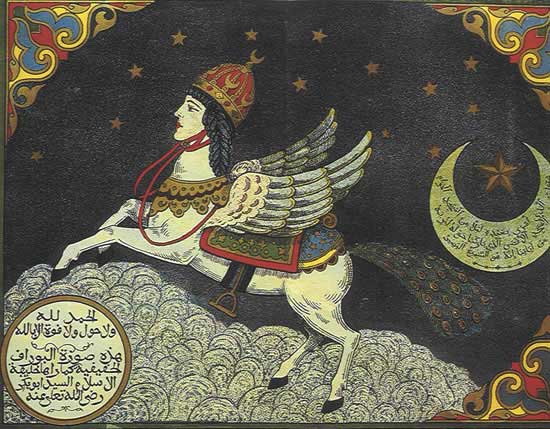
one of the stranger creatures to be described in literature is the Buraq
(Arabic “al-buraaq”, which means “lighting”), the “mysterious mount that
carried Muhammad on a miraculous journey” (Rosen 2009:104). “The Buraq is
described as white and long, larger than a donkey and smaller than a mule. It
has the face of a woman, he wings of an eagle, and the tail feathers of a
peacock. In a single stride it is able to gallop a distance equal to the range
of its vision.” (Rosen 2009:104)
 |
| Buraq |
The Lamassu
“In
Mesopotamian mythology, Lamassu help people fight chaos and evil. Each day,
they hold the gates of dawn open so that the Sun god Shamash can rise and also
help to support the weight of the Sun disc.” (Rosen 2009:287) The Lamassu is
described as combining the body of a bull or a lion, the wings of an eagle and
the head of a bearded man. Statues of these Lamassu can be found in the sites of ancient Babylonian
and Assyrian cities (Rosen 2009:287).
 |
| Lamassu |
 |
| Lamassu |
The Benu
Considered
the spirit of the Sun god Ra or of Osiris, “[t]he blue Benu bird was the
original mythical phoenix in some versions of the Ancient Egyption Heliopian
creation legend.” (Eason 2008:58)
“The Benu
bird perched on the first mound as it rose from the primal waters at creation
with the sun rising behind... They were considered creatures of rebirth. ...
The Benu is said to be consumed by flames every five hundred years, after which
the young bird rises, carrying the ashes of its parent, which it buries beneath
the sacred mound at Heliopolis, now an obelisk located in modern Cairo.” (Eason
2008:58)
 |
| Benufrom the Tomb of Inherkha |
Sources:
Easton,
Cassandra. 2008. Fabulous Creatures,
Mythical Monsters, and Animal power Symbols: A Handbook. Greenwood Press,London.
Rosen,
Brenda. 2009. The Mythical Creatures
Bible: The Definitive Guide to Legendary Beings. Sterling Publishing,London.



No comments:
Post a Comment